What is an AI Agent?
In the last year, we have seen a proliferation of agents across different verticals and different service segments, but what exactly is an AI Agent and how is it different from other software systems? Does your business need an agent? In this article, we will break what an AI Agent is, what use cases it fits, and what you need to build one.
Recent advancements in generative AI have resulted in the development of models that can use human language proficiently. These models, like GPT-5, Claude Sonnet 4.5, or Llama 4, are capable of reading, writing, and conversing which has enabled the automation of a plethora of daily tasks. These models have also created a paradigm shift in machine learning, from custom models trained to solve specific tasks to foundation models that can solve general tasks out of the box. Powered by trillions of parameters and trained on the whole of human textual knowledge, these large language models (LLMs) have become the cornerstone of a wide range of applications now termed Agentic systems1. AI Agents sit at the pinnacle of agentic systems, as of early 2026.
What are AI Agents and how do they work?
AI Agents have been defined as software entities designed to perceive their environment, make decisions and take actions to achieve specific goals. Most agents today are based on the ReAct (REasoning and ACting) framework that combines chain of thought (CoT) reasoning with external tool use. Unlike previous generations of agentic systems, ReAct combines Reasoning and Action, which allows these systems to do, not only to say. Non-agentic systems are akin to smart companions that can converse with you and give you information, whereas Agents are more like personal assistants that can actually do things on your behalf.
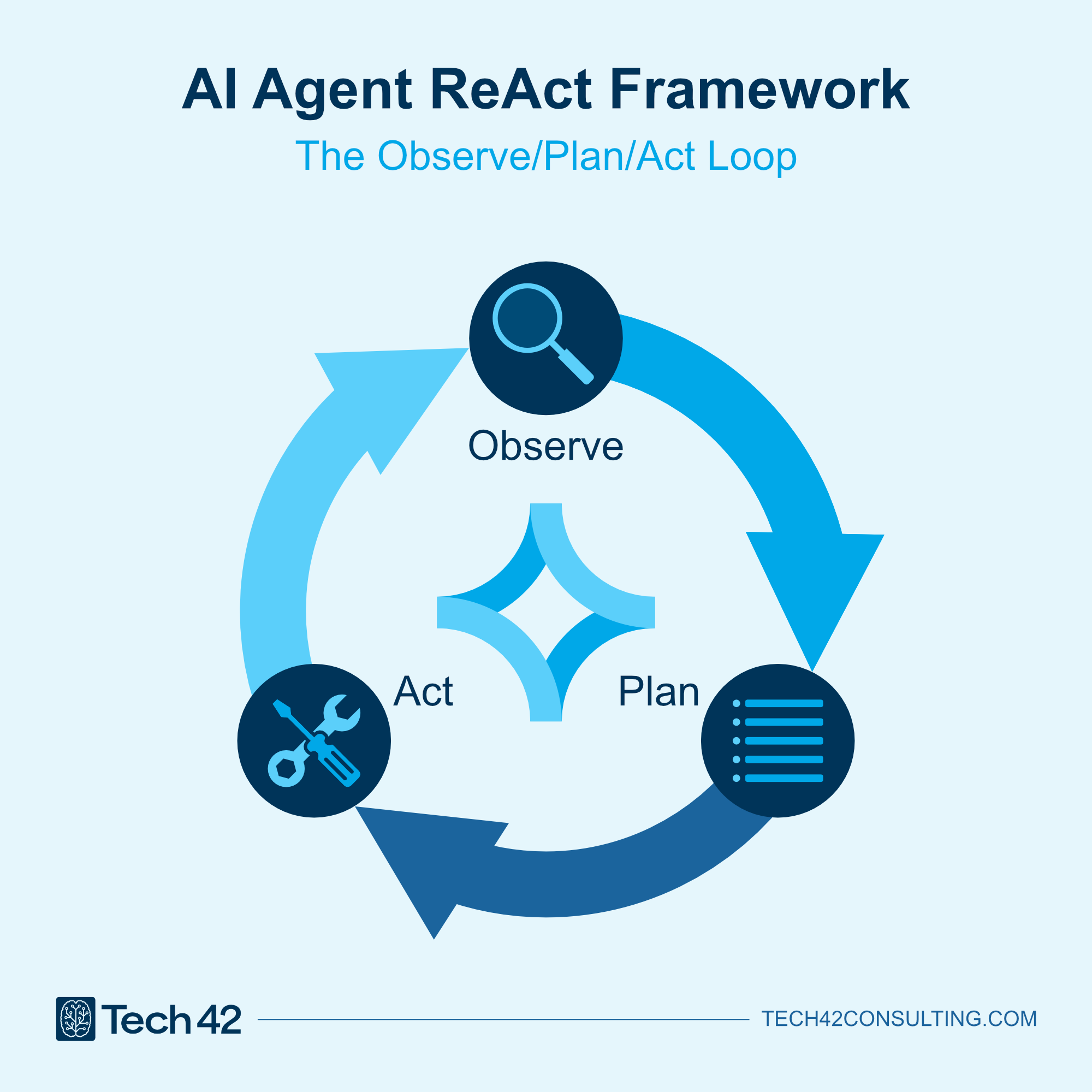
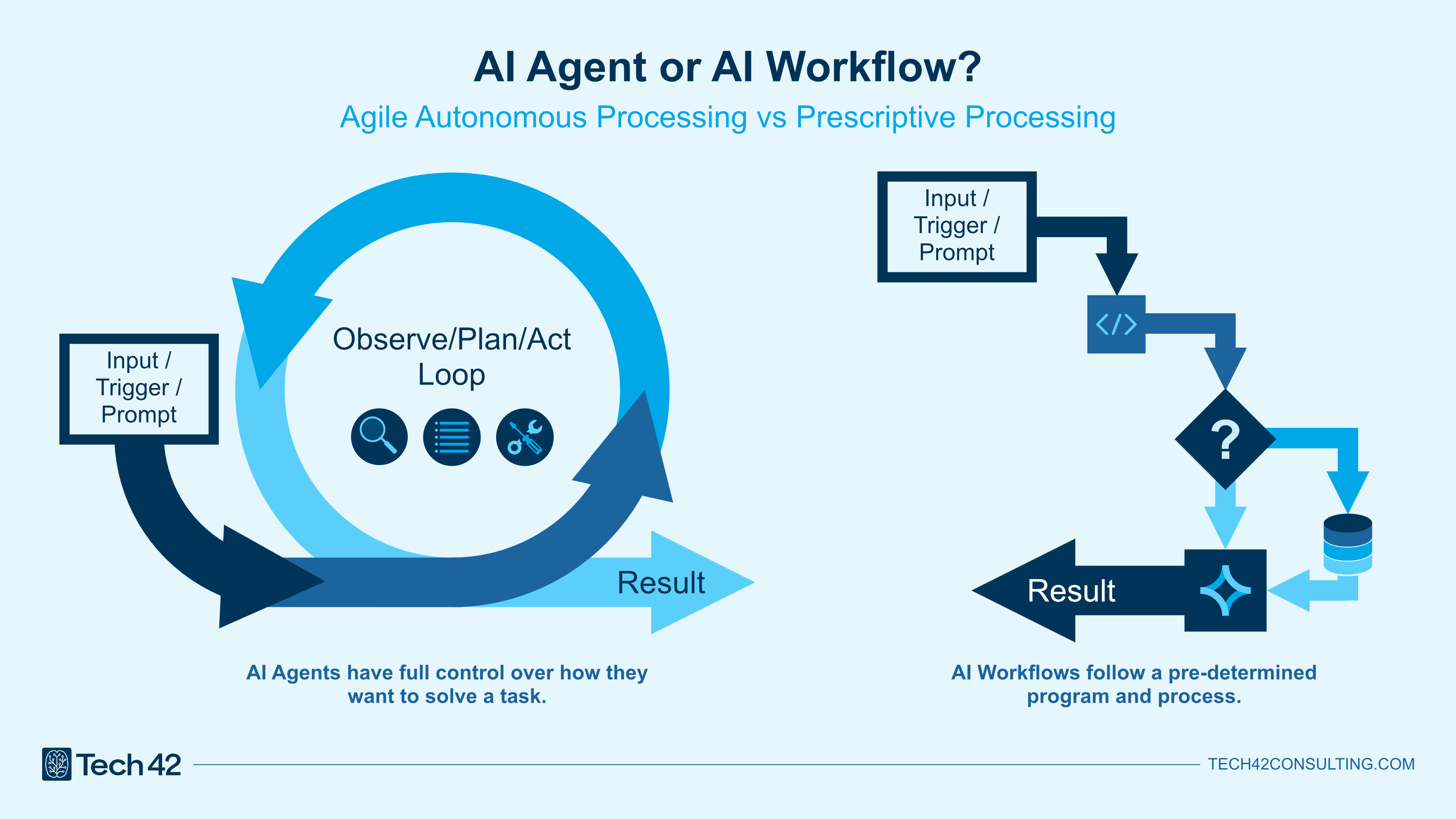
AI Agents primarily run in Observe, Plan, and Act loops: the agent will observe the user prompt, plan the tasks required to answer the query, then act by executing a tool it has access to. It will then loop back, observe the tool output, plan its next action, and act accordingly in repeated loops until it thinks it has completed the request in the user prompt. These Observe/Plan/Act cycles make the agent more Agile oriented, unlike older generation agentic systems which were more Waterfall in nature. As a result, AI Agents deliver higher performance but also increased latency and cost.
AI Agents vs Agentic Workflows
Agentic workflows are static graphs that route the agentic system into predefined steps in a premeditated order defined by the programmer at development time. In contrast, AI agents have dynamic control of the execution flow devised by the LLM at runtime.
As an example, let’s consider an application mimicking a robotic chef. If our chef application was designed as a workflow, we would define and code a specific flow of events, such as:
Receive Order -> Collect ingredients -> Cut vegetables -> Fry meats -> Serve dish
However, if the chef app is designed as an AI agent, we would create a “chef agent” with a toolbelt that would have skills like receive orders, collect ingredients, cut, fry, plate and serve. Instead of following one fixed path, the virtual chef picks and reorders tools at runtime based on real time context (missing ingredients, dietary requests, stove unavailable, etc.).
AI Agents have full control over how they want to solve a task from how to decompose the tasks into sub-tasks, to the tools used, to the order in which everything gets executed. This makes them great for tasks with ambiguous flows or ones where the flow is difficult to define and code ahead of time. On the autonomy scale, agents have greater independence than agentic workflows, giving them more flexibility to handle complex, open-ended tasks with minimal human intervention. This also makes them harder to control, evaluate, and debug.
[[agentcore_mp-cta1]]
Patterns and Anti-Patterns for AI Agents
Agents have been in the public eye for about two years now and are under heavy development. Their potential is huge, however, the technology — as well as the application space — is still rapidly evolving. Here are four questions to ponder to help you decide if AI Agents are right for your business:
1. Is the application mission critical, error sensitive, or in a highly regulated industry?
AI Agents have a mind of their own. Autonomy is the foundation of agentic behavior. It allows agents to function without continued supervision or hard-coded control flows. While this hands-off approach can work for a lot of applications, it is less desirable for mission critical, error sensitive, or highly regulated tasks. In those applications, agentic workflows or human-in-the-loop system design can help you balance the risk and reward of using AI.
2. Is the task path predictable or can it be predefined?
AI Agents are ideal for diverse tasks where the execution path is hard to define. For tasks with a static, predefined execution path, an agentic workflow can be cheaper, faster, and more robust.
3. Is the value of the task worth the cost?
AI Agents work in an Agile manner, executing loops of Observe, Plan, Act until they resolve the prompt. The task resolution is planned dynamically and the agent has full control over how to solve the task. This makes it harder to estimate the system’s cost in advance. The agent loop often results in higher costs than single-pass workflow systems. To ensure successful and long-term agent adoption, the automated task ROI must warrant the development and execution cost of the agent.
4. Is latency critical?
As AI Agents process through Observe, Plan, Act loops, this can add unpredictable latency compared to predictable, single-pass workflows. If latency is critical, a pre-defined workflow will offer more defined latency estimates and a more consistent user experience.
Our recommendation is to use an AI agent in cases where error is tolerable, open-endedness is appreciated, the execution path is harder to code, cost is not an issue, and latency can be tolerated. For other cases, consider an AI workflow.
Not sure whether your use case calls for an agent or a workflow? We can help you pick the right path and plan your approach. Book a consultation with our team.
Components of an AI Agent
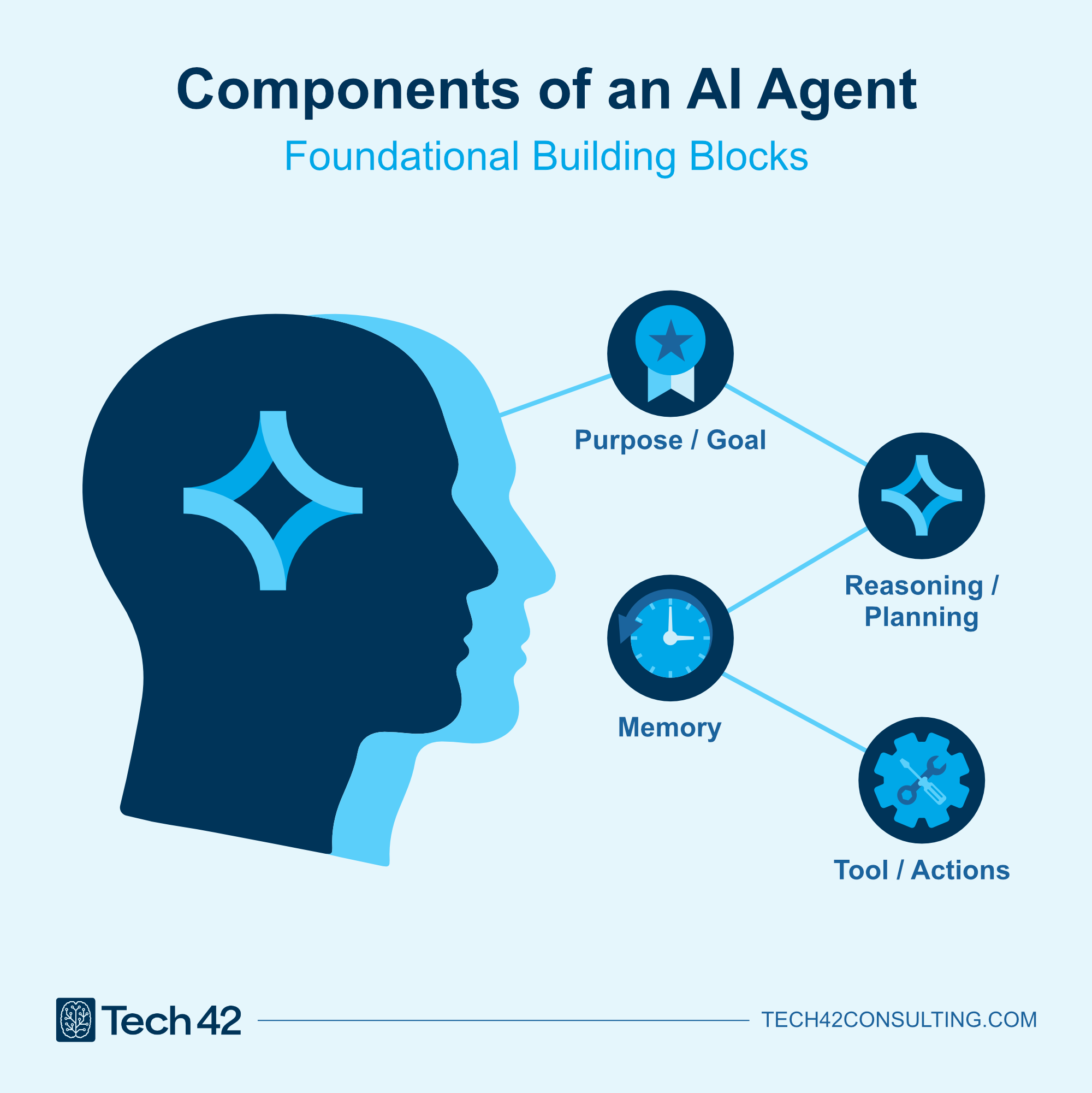
AI Agents are an active field of development and are constantly evolving. More and more components are being added as agents are polished and gain more adoption. However, the main components are:
1. Purpose/Goal
The AI Agent needs to have an Objective or Purpose. This is defined using the system prompt where the Agent is given its objective, instructions on how to behave, and its overall character, persona, and tone.
2. Reasoning/Planning
The Agent must be able to reason and plan in order to solve tasks. Reasoning and planning are provided by the LLM (chosen by the agent designer) which serves as the brain of the agent.
3. Memory
LLMs are stateless and do not retain information about user input. The agent needs memory to be able to interact with users and retain consistency throughout its agentic loop. Memory comes in two forms:
- Short-term which is usually accomplished through the context window of the LLM
- Long-term memory which is usually an external storage system that the agent has access to
4. Tools & Actions
Perhaps the most defining characteristic of an agent, beyond dynamic control of the execution path, is the ability to act. This often takes the form of function calls that can serve several purposes including capability extension, knowledge augmentation, or system orchestration. Tools are proliferating to include browser actions, code execution, filesystem control or even spawning new agents in the case of Deep Agents. Tools can help overcome several limitations of LLMs, including knowledge cut off and lack of access to real-time information.
Business Benefits of AI Agents
AI Agents have several advantages that can boost your business. We’ll cover these topics in more detail in future articles, but here are some of the most common benefits we see:
- Availability: Agents are available 24/7, 365 days/year and with a 99% uptime depending on how well they are built.
- Multi-lingual: Agents support hundreds of languages out of the box.
- Efficiency: A well-built AI Agent improves response time over humans.
- Consistency: AI Agents with clear rules and guidelines ensure more consistent support compared to different human agents.
- Convenience: AI Agents offer convenient self-service options to clients at their preferred time outside of regular office hours.
- Scale: Well-built AI Agents should scale up and down automatically based on traffic.
- Cost: AI Agents reduce business costs compared to hiring the human equivalent in productivity. This also gives the ability to focus humans on the most important and impactful work.
- Employee Satisfaction: AI Agents can alleviate many repetitive and monotonous tasks that humans prefer not to do.
Building Production Grade AI Agents
AI Agents can be extremely powerful. However, there is nothing more frustrating than an agent that does not work well or can’t scale with demand. Agents are multi-layer systems composed of an LLM layer, an agent component layer, and an application layer. For a production-grade, reliable agent, there are several topics that need to be understood and handled, for example:
- Model selection: Which model is best suited for my task? How do I balance inference cost with performance?
- Prompt engineering & context engineering: How do I instruct my agent in the most effective and efficient way to deliver consistent results? How do I ensure my agent has the context to succeed at tasks? How do I manage performance rot?
- Data management (storage, ranking, retrieval, …): Is my data structured in a way where the agent can retrieve it and perform the necessary tasks?
- Memory setup and management: How does my agent memory need to operate for optimal efficiency and user experience?
- Tooling: What tasks does my agent need to be able to complete?
- Interfaces (MCP, A2A, AG-UI): What interfaces does my agent need to achieve success?
- Architectural choices: What systems am I interacting with? How do I need my agent to function and scale?
- AgentOps (PoC to Production): What considerations are important for productionizing my agent?
- Deployment approaches: What infrastructure am I working with and how will I deploy my agent?
- Security & compliance (HIPAA, SOC-2, etc.): What security and compliance requirements affect my industry, customers, and users?
- Orchestration & communication for multi-Agent systems: what multi-agent architecture best fits my use case?
- Error Handling & remediation: What happens when an error is returned? What should the user experience be?
- Monitoring & observability: What level of observability and tracing do I need? Does my agent need to be auditable?
- UI/UX (streaming, latency, etc.): What is my end agent application and desired user experience? How will people interact with the agent?
AI Agents are continuously advancing and are being adapted to different use cases. Because agents often interact with clients, it is important that they are well engineered and implemented to deliver a smooth and pleasant customer experience and avoid eroding client trust. An experienced team can help you customize your agent to your use case and can help avoid common pitfalls.
Experimenting with AI Agents
Hopefully this guide gives you a better sense of what an AI agent is and how it differs from an AI workflow. If you are interested in exploring AI Agents for yourself, Tech 42 has made a free and open source starter pack deployment available through the AWS Marketplace. The starter pack is built with Amazon Bedrock AgentCore and deploys in a few steps and less than 10 minutes, so it’s an easy way to start testing. You can also estimate the costs of running your AI agent using our AgentCore cost calculator.
We are also available to help plan and execute proof-of-concepts and production deployments of AI agents and agentic workflows (here are some customer quotes from projects we’ve worked on). If you need any support with your agentic needs, please feel free to contact us.
1 Agentic Systems: a term coined by Dr. Andrew Ng in 2024 to serve as an umbrella term for all systems that have some level of “agency” and autonomy.

Rola Dali