How to know that your AI initiative will actually pay off
This guide answers one question: Where should we actually start with AI in our business, and how is AI going to impact us in the long run?
The companies getting real value from AI are the ones willing to dig into their business and think critically about their processes, opportunities, and customers. They're not waiting for a perfect plan. They're not chasing the technology for its own sake. They start with a specific business problem, figure out whether AI is the right tool for it, and build something that works before expanding.
This guide walks through that process and includes worksheets to guide you through specific parts of the process.
So, when will I know my ROI?
It’s important to note that ROI can't be calculated accurately at the beginning of this process. The number only becomes meaningful once you understand your business problem, your data, and what a realistic solution looks like. This guide builds toward a viable solution and accurate ROI. Shortcuts produce bad math and AI projects that never make it to production.
Part 1: Business first, technology second
AI conversations often start in the wrong place. They start with the technology and get bogged down into types of agents, large language models, and tech stack. Then they work backward to justify the business case. That approach produces projects that might seem interesting but have no grounding in business results.
The right starting point is your business. What outcome do you want to see for your business? This is generally rooted in improving the bottom line, but do you have specific goals for parts of your business?
Getting to the business case
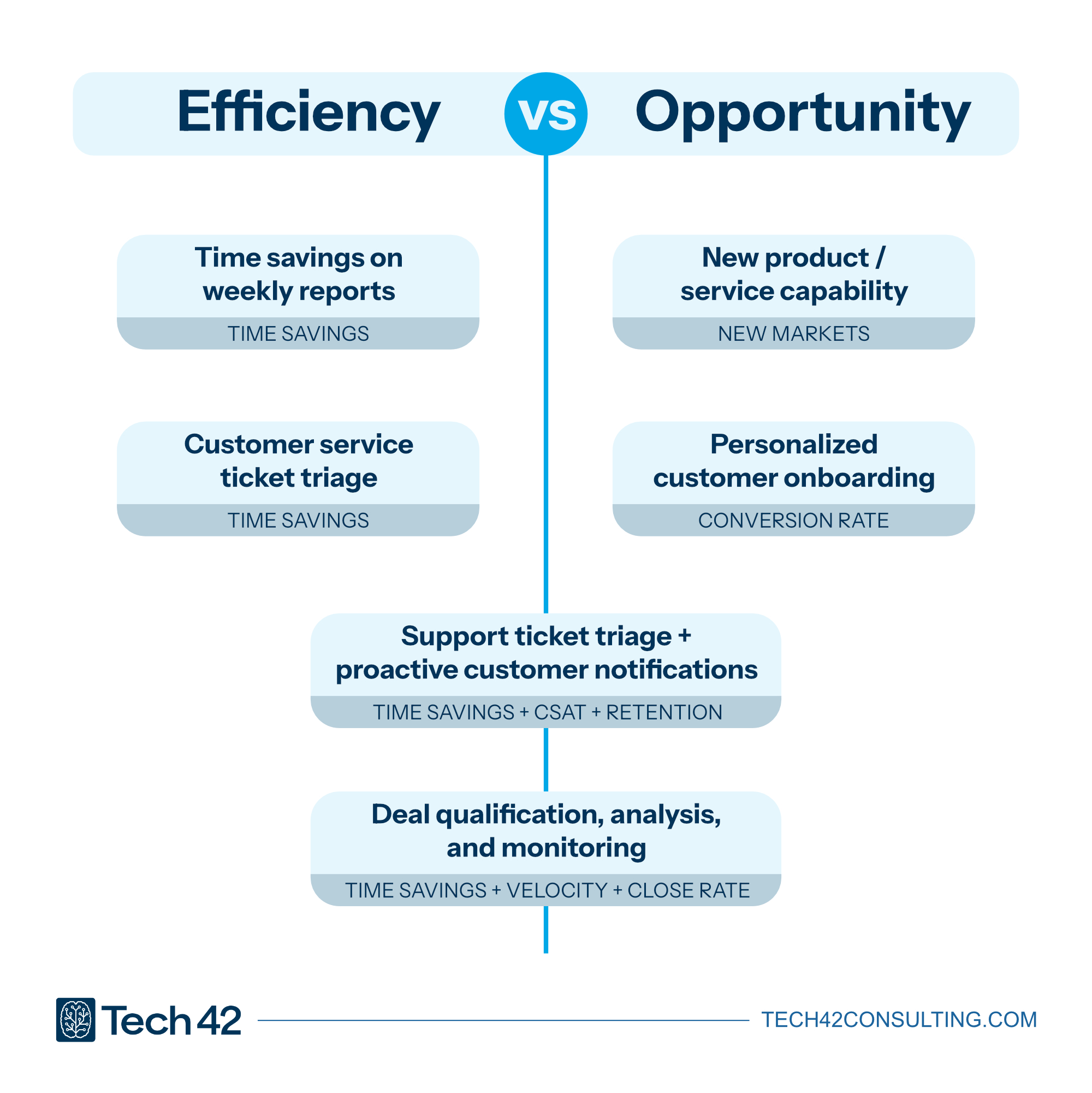
When you’re considering specific metrics to improve in your business, here are two ways to think about value:
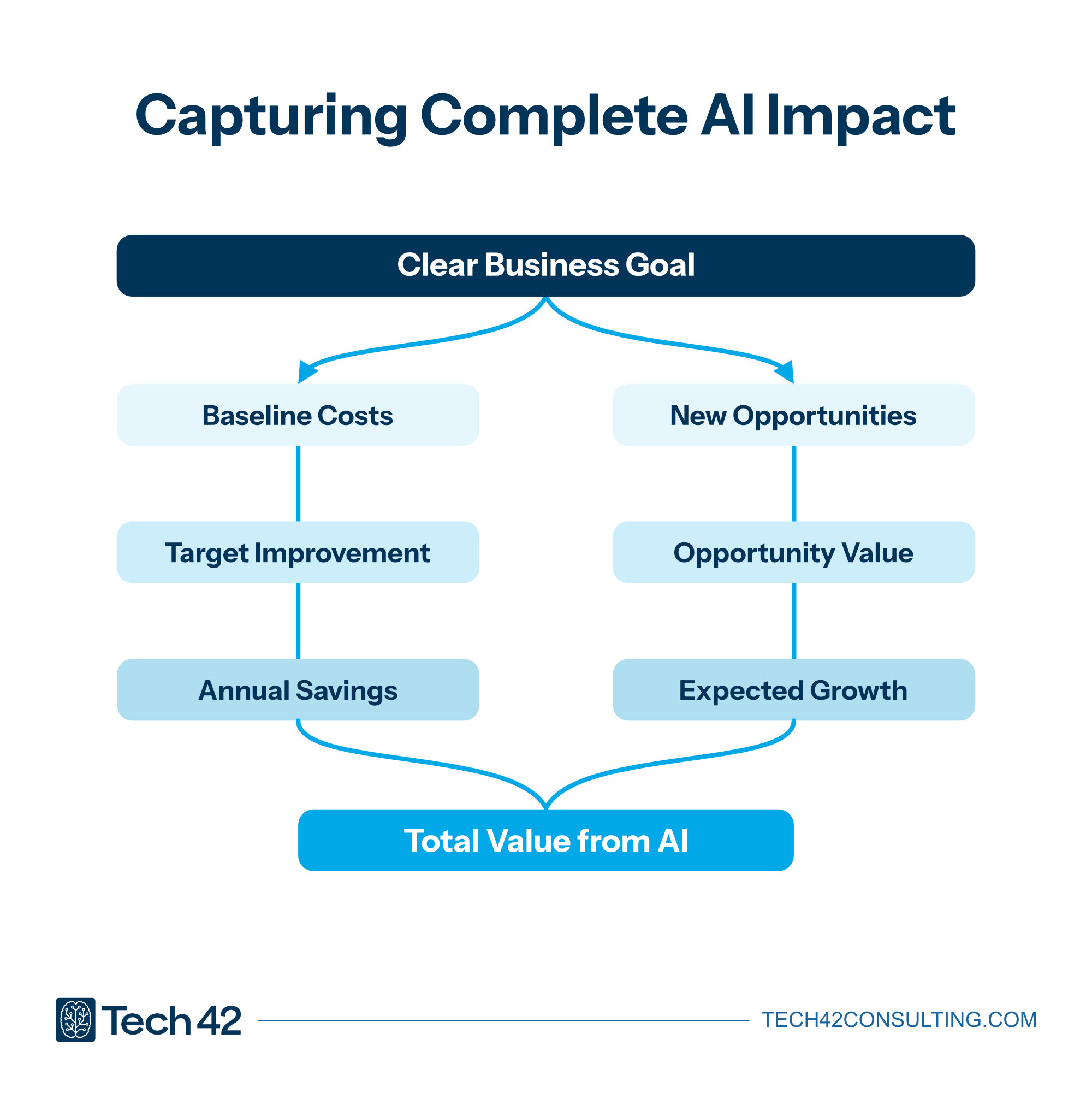
Save money through efficiency gains targeting existing operations. The goal is to reduce the time, cost, or error rate of work that's already happening. If a team handling 500 customer service tickets a day can reduce the time spent on each ticket, your efficiency per customer goes up, enabling you to handle more business without growing staff. Ultimately, saving money for your business.
Make more money through new opportunity targeting new capability or growth. Can you deliver a new service, service a new industry, or carve out a competitive advantage? A company sitting on a proprietary dataset can deliver value that no other company can. This could lead to new products, new go-to-market opportunities, or new customer experiences. Ultimately, new revenue for your business.
But keep in mind that efficiency and opportunity aren't mutually exclusive. Here are more practical examples of real goals:
- Improve CSAT scores (business result) through faster speed to ticket resolution (efficiency) and surfacing proactive customer notifications (opportunity)
- Improve revenue and conversion rates (business result) through personalized customer onboarding (opportunity)
- Reduce number of closed lost deals (business result) through better qualification (opportunity) and better processes (efficiency)
Defining specific, measurable business outcomes is essential to a successful AI project.
The strongest AI initiatives have defined business goals that have nothing to do with the technology. They know where they want to create value.
[[ai_opportunity-cta]]
Part 2: Map how your business actually works today
AI can't be built for a process that hasn't been mapped. If you can't describe exactly how a human handles a task today, step by step, including where they go to get information and what decisions they make along the way, there's nothing concrete enough to build against. That means no reliable ROI estimate.
Some companies are enamored with the prospect of AI, thinking that it can do anything. While it’s true that AI’s capabilities are accelerating faster than anyone expected, there’s no substitute for having clear requirements.
For companies that push forward without this, AI projects can eat up budget fast while getting stuck or producing bad results.
How to map your business processes
The mapping process is straightforward. Pick a single business process and document it as a human would do the work. Some questions to guide you:
- Where does someone start?
- What information do they access, and where does that information live?
- What judgment calls do they make, and what data informs those calls?
- What does a good outcome look like, and what does a bad one look like?
Two things typically surface during this exercise:
First, the process is more complex than anyone assumed. Steps that feel automatic to experienced staff involve decisions that need to be made explicit before they can be automated.
Second, the data the process depends on isn't always where it's supposed to be. It's in someone's inbox, in a spreadsheet someone built as a workaround, or in the institutional knowledge of a person who has been doing the job for ten years.
Both of these are useful discoveries. Finding them during a mapping exercise costs time. Finding them after a project has started costs money.
[[business_process-cta]]
Part 3: Understand your data and systems
Data is where most AI projects run into trouble. Not because the technology doesn't work, but because the data it needs isn't in the shape that was assumed when the project was scoped.
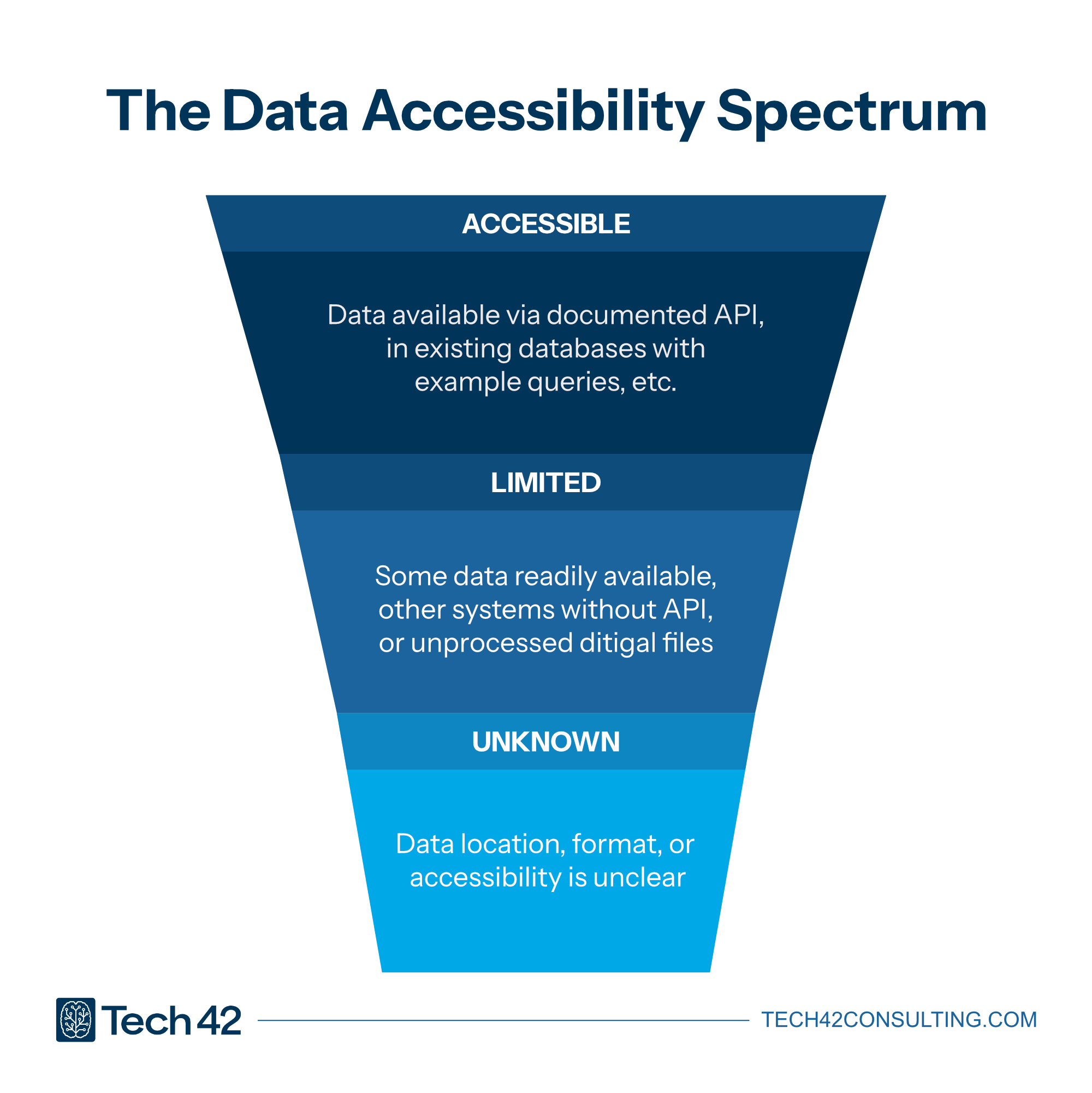
Three questions determine data readiness for any AI initiative.
Where does the information actually live? Not where it's supposed to live according to your systems diagram. Where it actually lives today. Policies that are supposed to be in the document management system but are attached to old emails. Customer records that are technically in the CRM but haven't been updated in two years. Institutional knowledge that exists entirely in the head of your most experienced employee. Data that’s simply gathered through human work, not a system that can be integrated with. An AI system can only work with data it can access. The gap between the official answer and the real answer needs to be understood before a project starts.
Is it accessible without a major engineering effort? In an ideal world, data should be accessible via well-documented systems and in a format ready for AI systems to take advantage of the data. When this isn’t the case, it could be an engineering project just to get data access and format to a point where an AI project can use it. This isn't a reason to abandon a use case, but it’s a major factor for scope and budget.
Do you have enough real examples to test against? This is data validation, and it's critical for the success and long-term maintenance of your AI system.
An AI system needs to be tested against real-world, human-verified examples before it goes into production. The standard starting point is 20 to 50 examples, including cases where the process went well and cases where it didn't. The whole goal is to give real world examples from your business so we can prove how well AI can do the job.
This matters for a specific reason. An AI system built without validation data can appear to work during development and fail in production. The gap between "it worked on the examples we tested" and "it works on everything it encounters in the real world" is closed by validation. Without it, you don't know which side of that gap you're on.
Collecting validation data also surfaces edge cases early. A process that works correctly 90% of the time but produces bad outputs 10% of the time needs a plan for that 10% before launch, not after. The answer is usually to route those cases to a human. But that decision needs to be made in the design phase, not discovered when a customer complains.
What about synthetic data? There are cases where this can work, but human-verified examples are best in most cases. We’re happy to walk through this with your specific use case.
Not confident in your data, systems, or use cases? Use our Business Process Mapping Worksheet as a guide for walking through these details.
Part 4: Define what success looks like before you build
We started with business results, then moved to processes and opportunities. Now we need to bring these together. What specific outcome did you expect to achieve, and how does that map to business value?
Too many AI projects start without a clear answer to a basic question: compared to what? An AI solution that reduces document processing time by 40% sounds like a win. Whether it's worth the investment depends entirely on how long that processing takes today, how often it happens, what it costs in staff time, and what a 40% improvement is actually worth to the business.
Define three things before any technical work begins.
The baseline. How does the process work today, in measurable terms? How long does it take? How often does it happen? How many people touch it? What does it cost? This is the number you're improving against. (Use our Business Process Mapping Worksheet to work through this.)
The target. What would a good outcome look like in specific terms? Not "faster" or "more efficient." A decision that currently takes two days should take two hours. A process that requires three staff members should require one. A question that currently goes unanswered after hours should get a response within 60 seconds. The more specific the target, the easier it is to evaluate whether a proposed solution will hit it and what’s required to get there.
The savings. What financial impact does this have on the business? This is what we’ll use to determine the ROI and if a project is viable. For example, if the process costs $200,000 per year in staff time and a solution costs $50,000 to build and $2,000 per month to run, a 40% efficiency gain pays back in under a year. You need a reliable savings target to make an accurate decision when the project cost is defined.
[[business_case-cta]]
Part 5: Assess Whether You're Ready to Build
Technical feasibility and organizational readiness are two different things. Projects stall on organizational issues more often than technical ones.
Technical readiness comes down to two things. First, the data is accessible and organized well enough to be useful. Second, there is a clear technical picture of how the solution works before anyone starts building. A well-thought out architecture diagram and a concrete description: what triggers the process, what data gets accessed, what the system does with it, what it produces, and where a human reviews or approves before anything reaches a customer or affects a business decision.
To put it directly: if you can't draw the solution on a whiteboard, you're not ready to build it.
Do this work in our Business Process Mapping Worksheet or schedule a session with our engineers to walk through this.
Organizational readiness comes down to three things:
- An executive sponsor who is committed and empowered to make budget and business decisions, not just someone who expressed interest.
- A stakeholder available to engage during the build, which means reviewing outputs, providing feedback, and making decisions in real time.
- Internal alignment on what you're building and why, not perfect consensus, but no unresolved disagreement significant enough to derail the project.
Two additional questions belong here that often get skipped.
Have you thought through compliance and governance requirements? Depending on your industry and use case, there may be regulatory considerations that affect how the system is designed. Data privacy, audit requirements, human-in-the-loop mandates, confidence thresholds for automated decisions. These don't need to be fully resolved before a project starts, but they need to be on the table.
Do you have a plan for the ongoing cost? Building the system is a one-time expense. Running it in production is a recurring one. Infrastructure costs, API costs, and maintenance need to be factored into the ROI calculation and budgeted for before the project begins. A solution that costs $3,000 per month to run needs to generate enough value to justify that expense on a continuing basis.
Our recommended process: Plan well, build small, prove results, expand
The best first AI project is almost never the most ambitious one.
The organizations that get the most value from AI put in the planning work, build something specific, prove it delivers value in their environment with their data and their systems, and use that proof point to justify the next project. The ones that struggle start with scope that's too broad, data that isn't ready, or an organizational environment that hasn't aligned on what success looks like.
A focused first project accomplishes three things beyond its direct business value.
- It proves that AI works in your specific technical environment.
- It gives your team direct experience operating an AI system.
- It creates a concrete reference point for every conversation about AI investment that follows.
Starting small isn't a lack of ambition. It's how you build the foundation for something bigger.
One pattern worth watching for: the edge case trap. During design and development, it's easy to spend disproportionate time on the scenarios that are unlikely but complicated. Note edge cases. Design an escalation path for them. Then move on. The 80% of cases the system handles well is where the value comes from. Don't let the 10% that requires a human block progress on the 90% that doesn't.
A Note on Build Partners
If you're working with an external team to build your first AI project, one question separates partners worth talking to from ones that aren't: do they ask about your data and your business process before they talk about the technology?
The first conversation should be about what you want to accomplish in your business. Then, they should help you walk through where your information lives, how your process actually works today, and what success looks like in measurable terms.
A partner willing to tell you when your idea isn't a good fit for AI or when you're not ready to build yet will help you find value faster and avoid wasting time and money. And a partner who leads with technology capabilities without understanding your business first is selling, not scoping.
It doesn’t matter where you are in your AI journey. Whether you’re exploring, you’ve had a failed pilot, or you’re optimizing for volume, we’re happy to give you confidence in your AI roadmap and walk through any section of this guide.
Worksheets referenced in this guide:
- AI Opportunity Planning Worksheet: A planning worksheet for leaders who need to move from "we should do something with AI" to a specific, prioritized opportunity
- Business Process Mapping Worksheet: A documentation worksheet for teams preparing to scope or build an AI project.
- AI Project Definition and ROI Worksheet: A scoping and ROI worksheet for leaders ready to evaluate a specific AI opportunity.
[[ai_toolkit-cta]]
Tech 42 Consulting helps organizations design, build, and deploy AI that works in the real world. If you've worked through this guide and want to pressure-test your thinking, our executive AI workshop is designed for exactly that conversation.