Real life AgentCore example: A personal agent to find Audible deals
I am a huge Audible fan! I’ve been a customer for years, and I have, so far, 410 titles and counting. Every month, audible releases thousands of titles on sale for over 70% off. I go through the sale list every month to select the titles I might enjoy, filter them based on Good Reads reviews (because Amazon and Audible reviews tend to be overly generous), and then purchase the select few that meet my criteria.
This is a tedious process that takes a day each month… Until this month! I sat down to build an Audible Deals Agent by leveraging our Tech 42 AgentCore free marketplace offering and Terraform Base Stack. It’s a few easy steps to deploy the Terraform Base Stack (instructions here), and what you get is an AgentCore Strands agent that can be adapted to many different use cases.
Here’s a walk through of how I built my Audible Deals Agent so you can see the process and get a few important notes as you build your own AI agent.
Audible Deals AI Agent Architecture
In this project, I adapted the base agent to collect the monthly Audible deals for me and store them in PostGres RDS. The agent can also access the collected deal, allowing me to interact with and select the deals I want to purchase. It also has access to a browser, allowing me to research specific books or topics directly through the agent.
Agent details
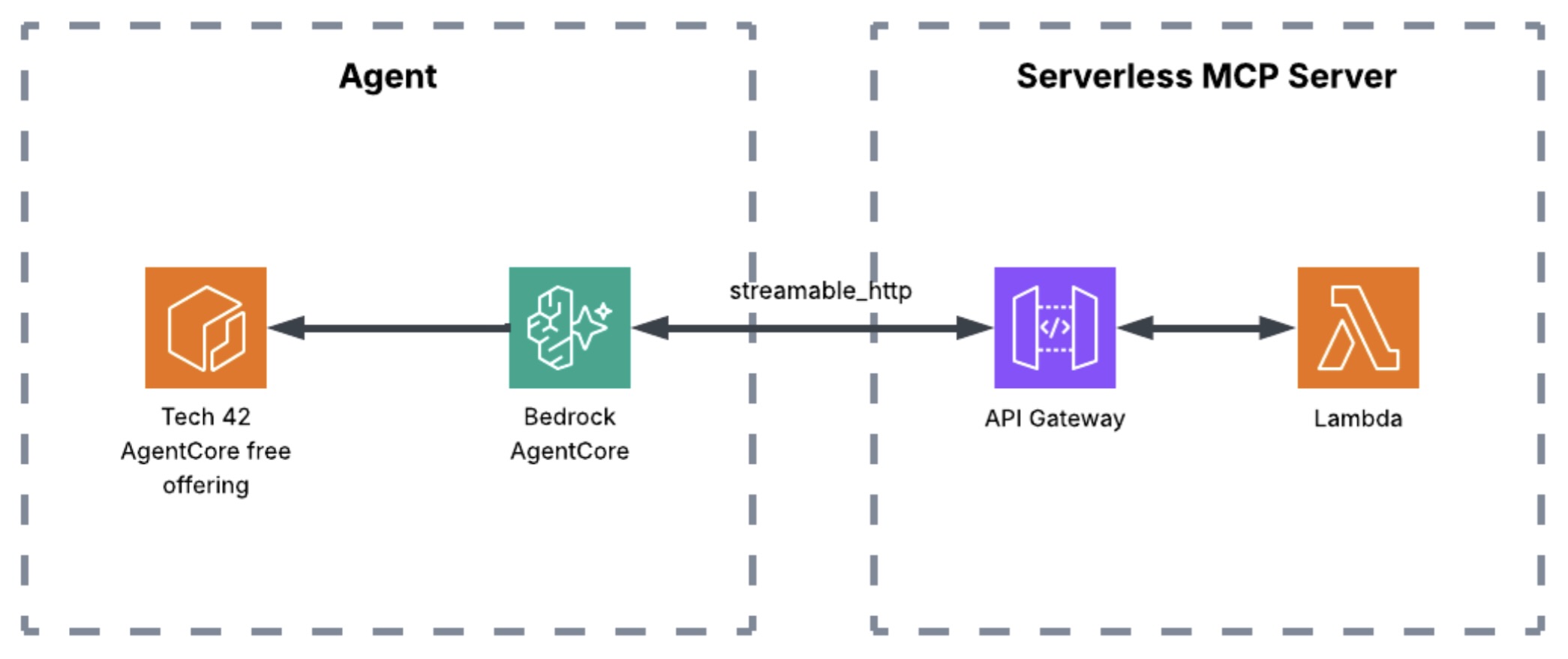
This is an AWS Strands Agent implementation provided free from Tech 42. The agent is deployed on AgentCore Runtime.
It comes with observability built in, either through LangFuse or ADOT, and it is easily extendable to Browser Integration and a Code Interpreter. I turned on Browser Integration to allow me to look up more information about book titles or look at reviews on other websites. I also added a 30 day short-term memory to the agent to help it retain preferences and information already discussed.
[[agentcore_mp-cta1]]
Storage & backend
The storage is a PostGres RDS instance since the collected information is structured and is very well suited for SQL queries. The credentials for the RDS are stored in Secrets Manager, allowing me to debug through PgAdmin.
In a real world use case, authorizing Lambda access to Postgres through the lambda IAM role would make a more secure architecture. This is just a fun example with public data, so access was kept open to allow you to look at the different pieces of the system.
Serverless MCP server
Given the infrequent usage of this agent, I wanted to keep costs low. I did this by building a serverless MCP server using AWS Lambda and AWS API Gateway. The MCP server has four tools:
- list_genres: To list the genres/categories for which Audible releases discounts.
- collect_deals: To scrape the deals for the current month. In my experience, Audible discounts over 1,000 titles each month.
- display_deals: To display to the user some of the collected deals.
- query_deals: To allow the agent to query the collected deals in natural language.
This MCP server is public and can be interacted with through MCPInspector.
You can add the `api_invoke_url` terraform output to MCPInspector and experiment with the server.
Security note: Server access was left open for learning purposes. In a real world scenario, adding authentication to the gateway or removing the gateway and connecting the lambda to the agent directly with access controlled by strict IAM would be a better architecture.
Agent deployment
Our goal with this project was to show what’s possible with AgentCore agents. The system is built in python and terraform and is hosted in a public repository on our github. Give it a try!
Frontend
The Frontend is a simple local streamlit app that allows you to talk to the agent. Turn on the “Debug” slider to look at the messages being sent back and forth between the different parts of the system.
Observability
Observability is crucial for monitoring and debugging a system. For this agent (or anything you build with the AgentCore Starter Pack in the AWS Marketplace), observability can be set through ADOT or LangFuse.
Set your LangFuse credentials in the Terraform stack and watch the traces in the LangFuse dashboard.
Cost of running the AI agent
This architecture is mainly serverless and runs on on-demand pricing when used, with the exception of the Postgres Database in RDS. Estimated costs are between $22/month for low usage (< 10K requests) to ~$130/month for high usage (1 million requests).
Here is a breakdown of the costs for the various tools and services used:
If you’re interested in seeing more examples of what it costs to run an AI agent with AgentCore, we have a couple of pre-built examples on our AgentCore Cost Calculator, or you can customize to your own use case.
A word about database security
Anytime an agent has access to data stores, the integrity of these data stores needs to be taken into account. Malicious actors can drop your tables, corrupt your data, or hack your system to add incorrect information. In this case, it was a playful colleague adding my future book titles.

Security note: Always put in the proper safety controls and test your system heavily.
Why we built this AI Agent project
Tech 42 released the free Strands agent offering that companies can adapt to their use case, like we did here for the Audible Deals Agent. Since you can approach an agent build from different directions, we wanted to provide two easy paths for getting started:
- The CloudFormation AI Agent stack and the full deployment guide
- The Terraform AI Agent stack the deployment guide
The agent complexity and details are abstracted away by Tech 42 and AWS AgentCore brings a variety of extensions, including memory, browser integration, code interpreter, observability, guardrails and much more.
Our goal with this offering is to allow companies to start their agent journey for free. Use the resources above and this article as inspiration for your next build. And if you need advice along the way, we’re here to help.
[[agentcore-accelerate-1]]

Rola Dali