Three ways to think about value and ROI from AI in your business
“What’s the return on investment for this?” It’s one of the most common questions we field, and it’s everywhere in the AI discourse. Major consulting firms are publishing studies like this one from PwC, stating that “just 20% of companies are capturing 74% of all AI-driven value.” Not to mention the viral (and questionable) MIT study in 2025 that talked about 95% of generative AI pilots failing.
So how do you unlock real value from AI? How should we be thinking about ROI in a time when hype is everywhere?
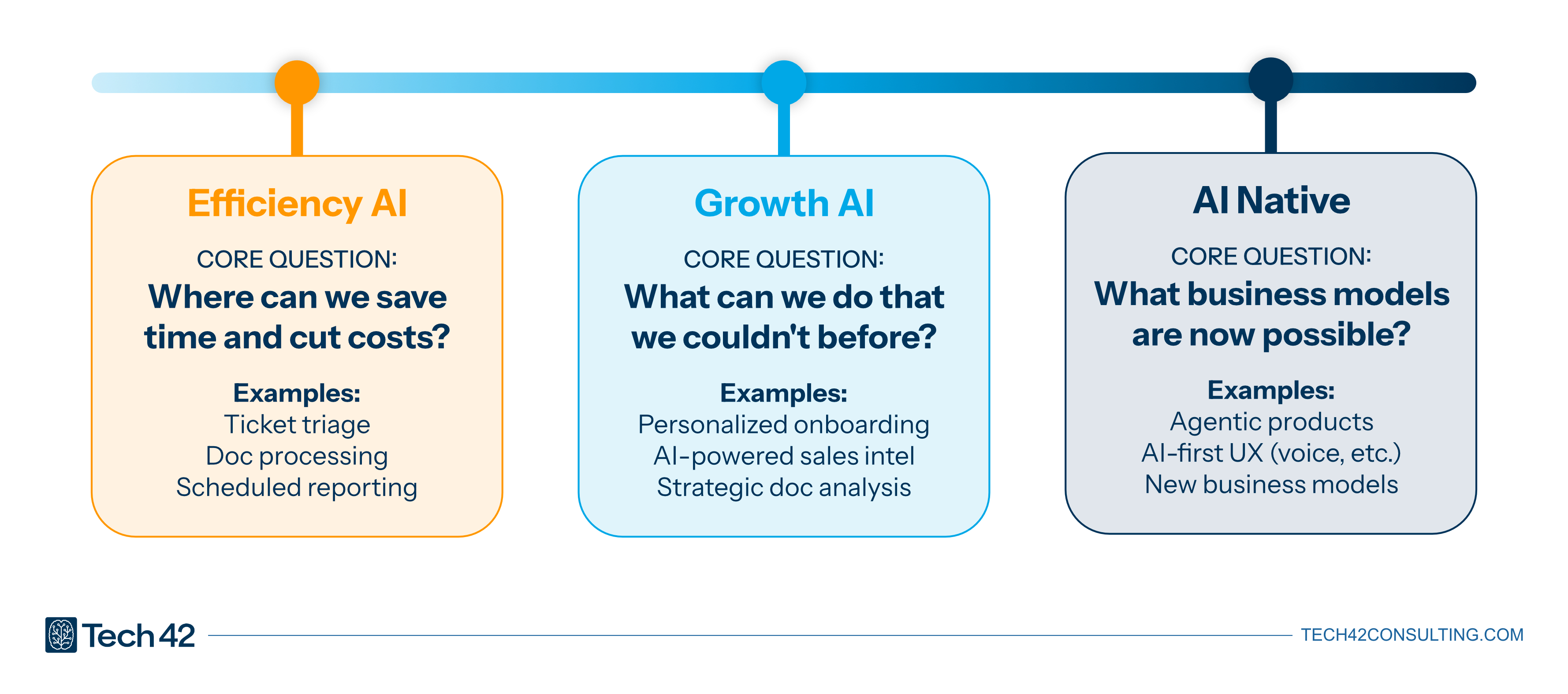
From our experience there are three major approaches to building with and thinking about the value created from AI:
AI for efficiency
Efficiency is where business leaders tend to turn first in their AI implementation. It’s the low-hanging fruit and the easiest place to spot opportunity in your business. This also happens to be where employees get most concerned about job displacement. The typical questions companies ask in this stage are:
- Where can we save time?
- How can we lower costs?
AI for efficiency looks like saving time on manual processes. Some examples include:
- AI agents that handle customer service ticket, email, or phone call triage
- AI-powered document processing that reduces manual document review or data entry time
- AI/ML workflows that handle repetitive processes
- Scheduled reporting or data analysis run by AI agents or workflows
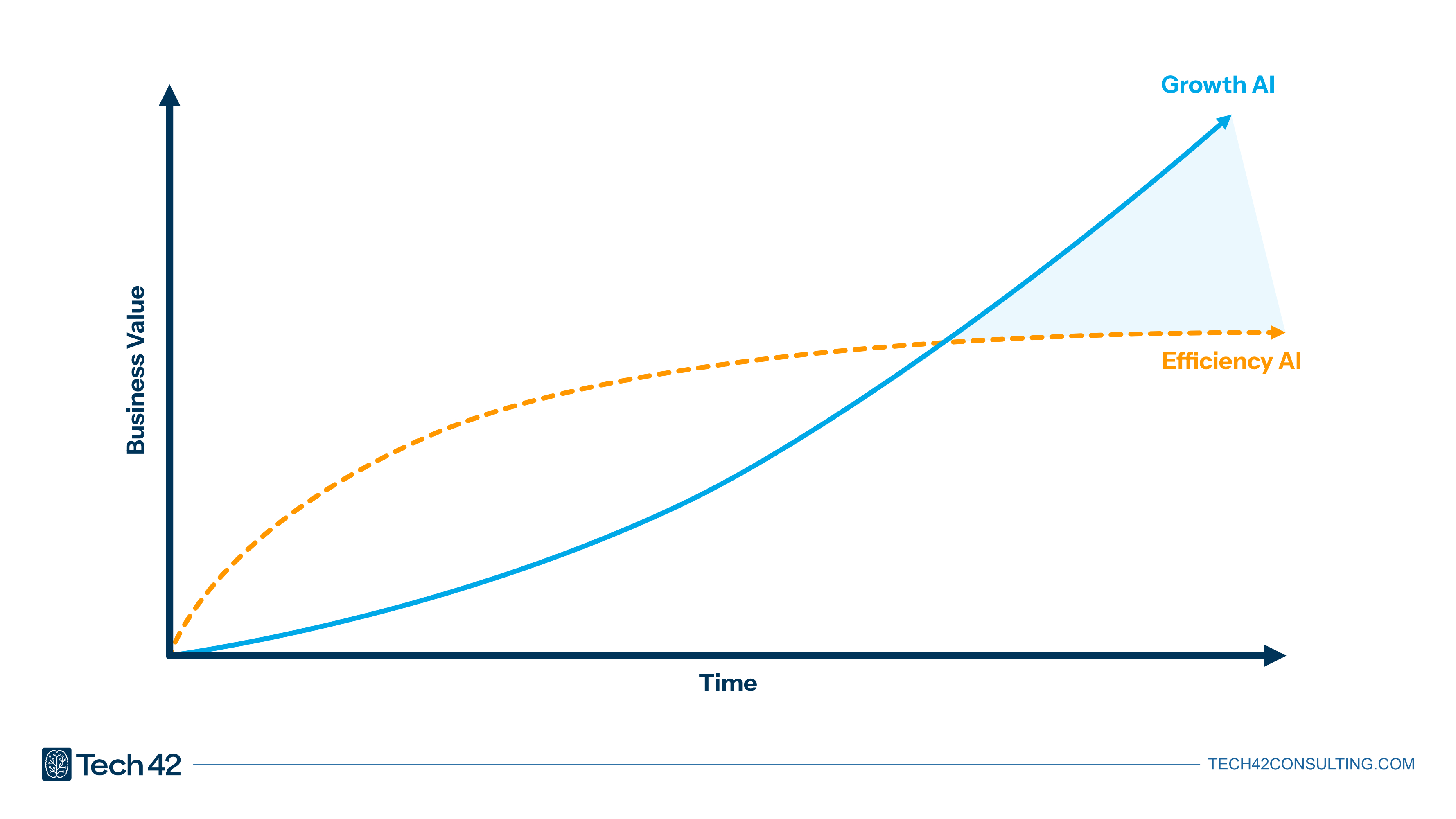
But the adage that “you can’t grow your business just by cutting costs” applies here. Let’s see how other companies are thinking about value.
AI for growth
If AI for efficiency is all about cutting costs, AI for growth is about uncovering opportunity. This means going beyond an AI chatbot to answer common questions and thinking about leverage and capabilities that you previously couldn’t deliver.
- What can we do to add value to or improve customer experience?
- How can we separate our company from the competition?
- How can we share and scale AI learning across our organization?
AI for growth looks like building new capability that adds leveraged value and opportunity. Goals at this stage are to delight customers, expand your customer base, or deliver new products and services. Some examples include:
- Use AI agents to create personalized onboarding experiences that help customers
- Using AI to help sales teams uncover new, better qualified opportunities
- AI-powered document processing workflows that flag for strategic risks or opportunities rather than simply extracting data
This is an approach that pairs well with efficiency initiatives where you can redeploy time saved into new capabilities, helping employees to upskill and see opportunity through AI. This is also where ROI compounds because you’re creating new value, not just reducing cost.
AI native
The AI native approach is all about industry disruption and building business models that weren’t previously possible. No shock that this is the approach of many recent startups.
AI native companies view AI as the central foundation to their business model. Not an efficiency tool. Not even a growth tool. They’re using AI to rethink what’s possible. Some examples include:
- Entire solutions or products around agentic capabilities
- Development of new AI models to power research, innovation, and content
- Products with completely different user experiences (e.g. voice-first, etc.)
For these companies, their business wouldn’t exist without AI. Most traditional businesses don’t fit in this category, but some leaders are willing to completely reinvent their business model around new capabilities.
How to take the next step with AI transformation
We work with companies at every stage of this continuum. Efficiency isn’t a bad place to start, but stopping there won’t lead your organization into maximizing value delivered from AI.
Here are four best practices to fuel the practical integration of AI into your business rather than getting stuck in the mire of AI pilots.
Know what’s possible
Companies that know what’s possible with AI are able to move from efficiency to growth AI. But this is about more than keeping up with the AI hype cycle. You need to know the new features and capabilities, the use cases these unlock, and the practical limits.
Build solid foundations
Data is the foundation of any AI initiative. That means it’s one of the most common blockers to any proof-of-concept. Make sure you’re building data and system foundations that can enable your best AI use cases.
Track business impact
Not every AI pilot succeeds. But trying things is how you uncover use cases, foundational roadblocks, and determine team readiness. Tracking business impact will help you clarify the ways AI can impact your business and unlock investment for future initiatives.
Never stop learning
We’ve never seen a time when technology advanced this quickly. A roadblock today could be completely solved next week. Keep learning and listening to new developments, what your competition is doing, and what AI leaders are trying.
[[ai_toolkit-cta]]
What separates companies that transform from companies that optimize
The three trends we see across clients are consistent: companies that understand the business value of AI have the greatest production success, companies with a roadmap get more value than those going proof-of-concept to proof-of-concept, and companies that invest in data and foundational systems implement faster.
But here's the pattern that matters most: companies that stop at efficiency don’t capture the full value of AI in their business.
Efficiency gains are real and they are important for funding future investment, but by themselves, they don't compound. To make headway against the competition, companies need to move into growth AI.
AI shouldn't just be about doing what you do cheaper. It needs to move to doing things you couldn't do before.
If you want to map where your organization sits on this continuum and what the path forward looks like, our executive AI workshop is designed exactly for that.

Andrew Thomas