AI Model Training: Choosing the Right AWS Infrastructure
Choosing the right infrastructure for AI model training can feel daunting. AWS offers several viable options, each with different levels of operational complexity, flexibility, scalability, and cost optimization.
We created this guide to help you navigate the options and select the approach that best fits your team’s experience, workload, and business goals. Our objective is to help you choose an AWS infrastructure option that meets your current needs without overengineering the solution or limiting your ability to scale.
Working through the AI model training continuum
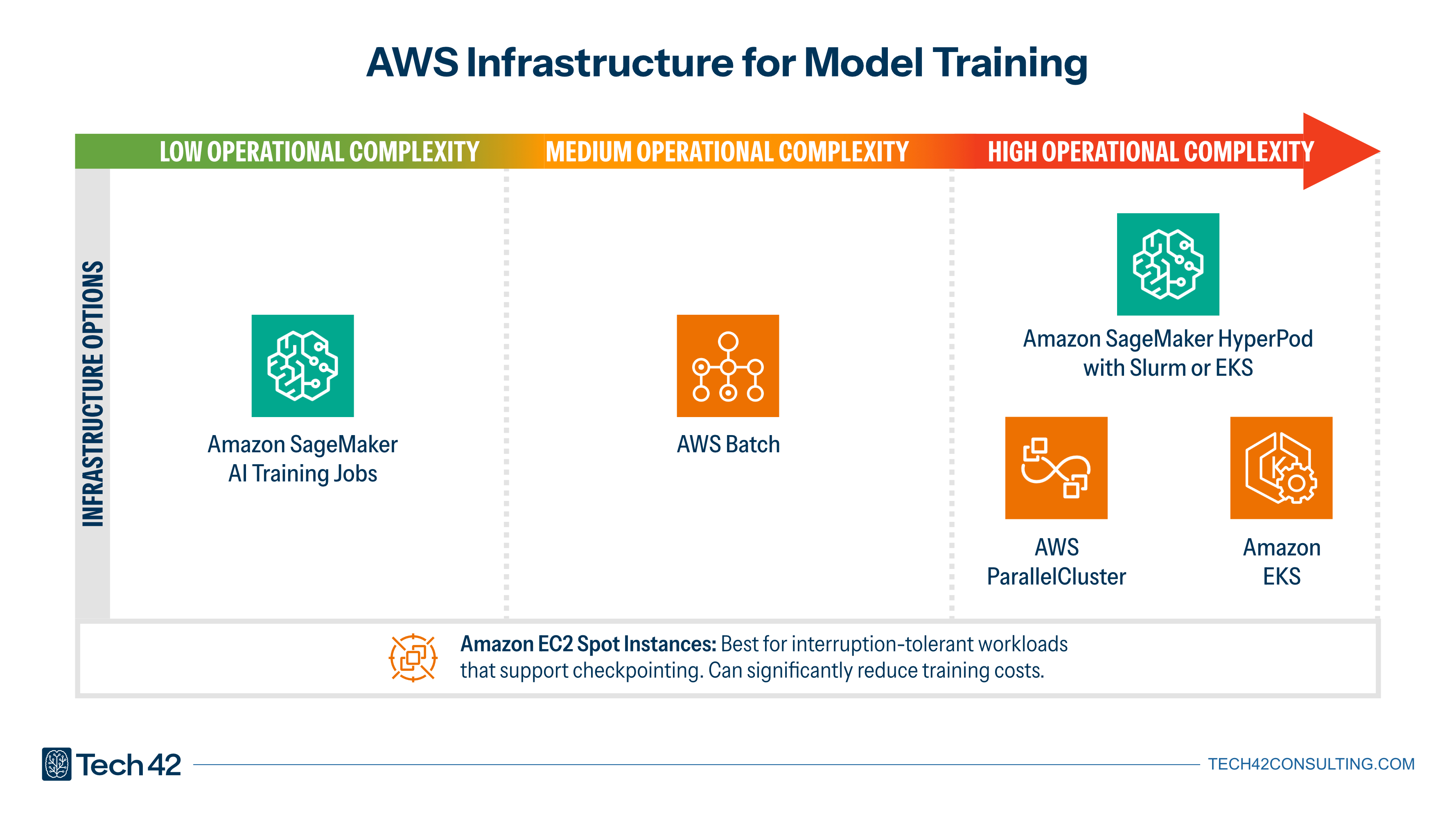
Figure 1. AWS infrastructure options for AI model training, organized by relative operational complexity. Amazon EC2 Spot Instances can reduce costs across supported architectures when workloads tolerate interruptions and have checkpointing implemented.
Start with the simplest platform that meets your needs (low complexity)
If your team is beginning to explore large language model workflows like supervised fine-tuning (SFT), LoRA or QLoRA, Direct Preference Optimization (DPO), model evaluation, or small-scale pretraining experiments, we recommend starting with a managed option like Amazon SageMaker AI training jobs.
SageMaker AI provisions the required infrastructure, runs the training workload, captures logs and metrics, and releases the resources when the job finishes. This reduces the need to build and operate a dedicated training platform, allowing your team to focus on the model, data, and training code.
SageMaker AI training jobs work with popular tools and frameworks such as PyTorch, Hugging Face Transformers, TensorFlow, DeepSpeed, and PyTorch Fully Sharded Data Parallel (FSDP). They support both single-instance and distributed training, making them a practical starting point without preventing future growth.
For interruption-tolerant workloads, SageMaker AI Managed Spot Training can reduce compute costs by using spare Amazon EC2 capacity. Because Spot Instances can be interrupted, your training code should save checkpoints regularly and be able to resume from the latest checkpoint. For short, time-sensitive, or non-restartable workloads, On-Demand Instances are a safer choice.
Scaling existing training code with limited platform experience (medium complexity)
Your team may already have training code built around a particular framework or runtime. If adapting that code to the SageMaker AI training-job environment would require significant effort, AWS Batch offers a more general-purpose alternative.
With AWS Batch, you can package your existing code and its dependencies as a container image, define its resource requirements, and submit it as a job. AWS Batch then provisions or selects the required compute capacity, schedules the job, and scales the capacity down when it’s no longer needed.
AWS Batch can run jobs on Amazon EC2 instances optimized for different requirements, including CPU-, memory-, and GPU-intensive workloads. It can also run CPU-based container workloads on AWS Fargate, allowing your team to execute jobs without managing the underlying servers.
AWS Fargate does not currently provide GPU capacity. GPU training jobs must therefore use an Amazon EC2- or Amazon EKS-based AWS Batch compute environment.
This flexibility introduces additional operational responsibility. Your platform now includes concepts such as compute environments, job queues, job definitions, container images, networking, permissions, and storage. Your team must also coordinate multistep workflows, including data preparation, training, evaluation, and model registration, through the application or a workflow orchestration service.
AWS Batch is a strong option when you want to reuse existing containerized training code and need greater control over compute selection, but you are not yet ready to operate a permanent training cluster.
Building a shared, scalable training platform (high complexity)
As the number and size of your training workloads increase, managing them as isolated jobs may no longer be sufficient. Multiple teams may need to share expensive accelerators, schedule competing workloads, enforce priorities and quotas, and run distributed training across many nodes.
At this stage, a dedicated training platform may be justified.
Slurm is a natural option for teams familiar with high-performance computing and large distributed workloads. AWS ParallelCluster can help provision and manage Slurm-based clusters on AWS while still giving your team substantial control over the underlying environment.
Amazon EKS may be a better fit when your organization already uses Kubernetes or wants to consolidate training, evaluation, and inference on a common container platform. Tools such as Kubeflow can provide machine-learning workflows on Kubernetes, while Ray can support distributed Python and AI workloads.
These platforms offer considerable flexibility, but they also require experience with cluster administration, workload scheduling, observability, networking, security, upgrades, and capacity management. The additional operational investment is most valuable when several teams and workloads can share the platform.
Protecting long-running, large-scale training workloads
Infrastructure failures become more likely and more expensive as distributed training jobs grow and run for days or weeks. A failed node can interrupt the entire workload, leave expensive accelerators idle, and force the job to restart from an earlier checkpoint.
Amazon SageMaker HyperPod provides long-running, resilient compute clusters orchestrated through either Slurm or Amazon EKS. Its health-monitoring and recovery capabilities can detect faulty infrastructure, replace unhealthy nodes, and help restart supported training workloads.
HyperPod is particularly valuable when accelerator utilization, distributed-training performance, and recovery from hardware failures justify the investment in a persistent training platform. It can support organizations running large-scale pretraining, frequent distributed training jobs, or shared accelerator environments across multiple teams.
HyperPod does not remove the need for application-level resilience. Most workloads should still implement checkpointing, store checkpoints on durable storage, and test their recovery process before beginning a long-running training job.
Amazon EC2 Spot Instances can also be incorporated into supported HyperPod configurations for workloads that can tolerate interruptions. Teams may combine Spot and On-Demand capacity to balance cost savings, availability, and completion-time requirements.
Choose based on your current requirements
The most flexible platform is not automatically the best platform. A simpler managed service often allows a team to deliver results faster and with less operational risk.
Here’s our recommended framework:
- Amazon SageMaker AI training jobs: Choose when you want a managed experience with minimal infrastructure ownership.
- AWS Batch: Consider when you want to reuse containerized training code and need greater control over compute selection.
- Slurm, Amazon EKS, or AWS ParallelCluster: Use when workload scale and shared infrastructure justify operating a dedicated platform.
- Amazon SageMaker HyperPod: Consider when large-scale, long-running training makes infrastructure resilience, accelerator utilization, and automated recovery critical requirements.
The right architecture is the simplest one that meets your requirements today while providing a practical path for future growth.
If you have questions or need support setting up your training infrastructure, our team has experience across this entire continuum, including production model deployment. Check out our Archetype AI case study or book a call with our experts.

Elmer Real