Archetype AI is building at the Physical AI frontier, training Newton, a foundation model that understands and reasons about the physical world through multimodal sensor data. Serving the sensor economy, Archetype enables industries like construction, manufacturing, energy, and logistics to extract AI insights from cameras, accelerometers, acoustic sensors, and more, while keeping data private and deployable at the edge.
To reach enterprise customers at scale, Archetype needed a production-grade cloud platform capable of meeting rigorous security and compliance requirements, including support for AWS-hosted and on-premises deployments in air-gapped environments. Archetype partnered with Tech 42 to build that AI infrastructure on AWS using Terraform, Amazon EKS, and a multi-account architecture designed for security, flexibility, and operational excellence.
The results:
- ~60% reduction in enterprise sales cycle length
- ~40% faster infrastructure deployment velocity
- <10ms cache round-trip latency for inference workloads
Challenge: Scaling a Physical AI platform to enterprise-grade infrastructure
Archetype Platform is architecturally unique: it must process high-throughput, multimodal sensor streams with low latency while supporting GPU-accelerated inference workloads at the edge and in the cloud. This created a distinct set of infrastructure challenges that off-the-shelf solutions could not address out of the box.
Key challenges included:
- Latency-sensitive compute placement: GPU and CPU workloads needed to be co-located in the same availability zone to minimize cross-AZ network overhead during inference.
- Multi-environment lifecycle management: Separate development, staging, and production environments had to be managed consistently across AWS accounts without configuration drift.
- Enterprise compliance readiness: Customers in manufacturing and construction demand SOC 2-aligned controls, network isolation, private subnets, encrypted storage, and auditable access patterns.
- AWS Marketplace distribution: Archetype needed a dedicated Marketplace account with its own ECR repositories to publish and distribute containerized versions of Newton to enterprise buyers.
- Deployment flexibility: The same platform needed to support both fully-managed AWS deployments and customer-premise packaging for air-gapped or restricted environments.
Outcome: An enterprise-ready platform for Physical AI
Through its partnership with Tech 42, Archetype Platform now operates on a production-grade AWS infrastructure that supports the full lifecycle of Newton, from model training and experimentation in development to enterprise customer deployments through AWS Marketplace.
~60% reduction in enterprise sales cycle length. The Marketplace-ready, SOC 2-aligned platform eliminates weeks of security review and procurement friction, compressing what typically takes 3–6 months for enterprise onboarding in manufacturing and construction down to 6–8 weeks.
~40% faster infrastructure deployment velocity. Fully automated GitHub Actions CI/CD pipelines with Terraform IaC across all environments reduced manual deployment effort and cut iteration cycles compared to ad-hoc cloud provisioning.
<10ms cache round-trip latency for inference workloads. Single-AZ colocation of GPU nodes, CPU nodes, and the Valkey (ElastiCache) cluster eliminated cross-AZ network overhead, delivering single-digit millisecond cache latency for Newton's real-time sensor analysis workloads.
"The architecture Tech 42 built gives us the confidence to go to market with enterprise customers who have high security and compliance bars," says Keith Klumb, Head of Technical Program Management at Archetype, shared. "We can now focus on training Newton and delivering value to our customers, knowing the infrastructure foundation is production-ready."
Technical Details: Building a production-ready platform on AWS
Architecture overview
Multi-account AWS architecture
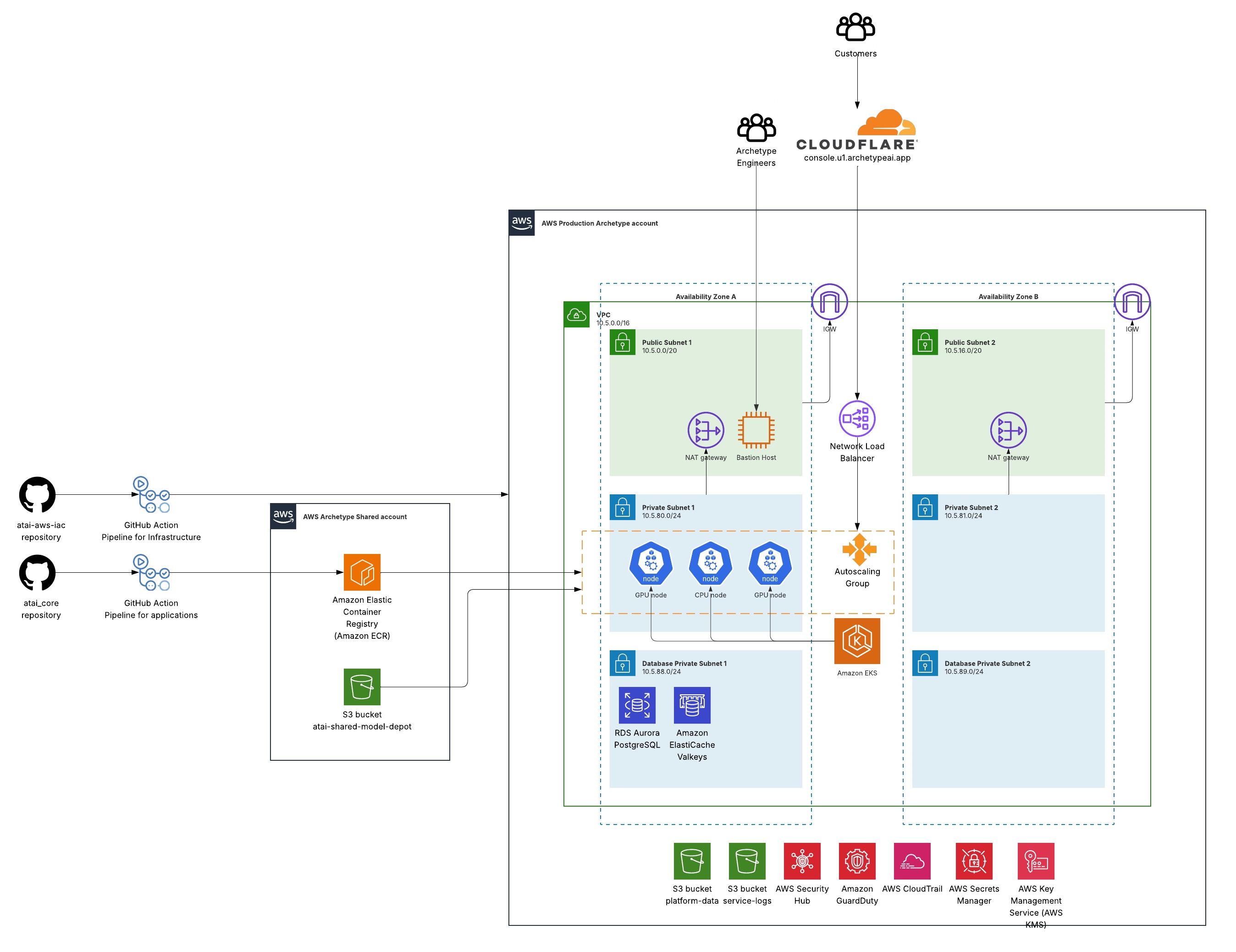
Tech 42 designed Archetype's infrastructure around an AWS multi-account strategy that isolates concerns across the platform lifecycle. The architecture spans five account tiers:
This separation ensures that a misconfiguration in a development environment can never propagate to production, and that Marketplace artifacts remain cleanly isolated from internal platform resources.
Network architecture
The network design follows a three-tier subnet model, purpose-built for Newton's latency requirements:
- Public Subnets (/24): Host Network Load Balancers and bastion hosts. Multi-AZ distribution ensures NLB high availability.
- Private Application Subnets (/20, ~4,096 IPs each): Host the EKS managed node groups. Oversized intentionally to accommodate all CPU and GPU pods concentrated in Availability Zone A, eliminating cross-AZ latency between inference pods.
- Private Database Subnets (/24): Isolated subnets for Aurora PostgreSQL and Valkey (ElastiCache), with NAT Gateway access for patching. The Valkey cluster is pinned to AZ A to match compute placement, minimizing cache round-trip times.
Compute: Amazon EKS with GPU acceleration
The compute backbone is Amazon EKS (Kubernetes 1.33), with a managed control plane spanning multiple AZs for high availability. Two managed node groups underpin Newton's workloads:
- CPU Node Group: Runs general application services, API layers, and orchestration workloads in AZ A.
- GPU Node Group: Runs ML inference workloads for Newton's LBM in the same AZ A private subnet, with the NVIDIA Device Plugin deployed as a Kubernetes daemonset to expose GPU resources to pods.
Critical EKS addons include the AWS VPC CNI for pod-level networking, EKS Pod Identity Agent for workload identity management, CoreDNS for service discovery, and the AWS Load Balancer Controller for dynamic NLB/ALB provisioning.
Cluster autoscaling is managed via the Cluster Autoscaler, with configurable min/max/desired capacity tuned per environment.
Cert-manager handles TLS certificate lifecycle across services, and the NGINX Ingress Controller manages HTTP routing within the cluster.
Storage
Three S3 bucket tiers support the platform's data architecture:
- {project}-{environment}-service-logs: Centralized logging for all application and service logs per environment.
- {project}-{environment}-platform-data: Environment-scoped data storage for Newton's sensor data and platform artifacts.
- atai-core-shared-model-depot: A globally accessible bucket in the Shared account that stores Newton's model weights and artifacts. Cross-account IAM policies grant controlled read access to the Dev, Stage, and Prod environments—ensuring a single source of truth for model distribution.
All buckets have public access blocks enforced and versioning enabled where applicable.
Databases
Aurora PostgreSQL clusters provide persistent relational data storage for platform metadata, user configuration, and customer onboarding records. All clusters are deployed with Multi-AZ configurations to meet AWS RDS subnet group requirements and ensure availability during zone-level events.
Valkey (ElastiCache), a Redis-compatible caching layer, handles session storage and high-frequency inference metadata caching. Cluster mode is enabled for horizontal sharding, and the cluster is pinned to AZ A to remain co-located with the EKS node groups, reducing cache latency to single-digit milliseconds.
Security and access management
All infrastructure access is federated through AWS IAM Identity Center (SSO) via the organization's SSO portal at archetypeai.awsapps.com. Engineers authenticate once and select account-level roles (Administrator or ReadOnly), with tokens refreshed via aws sso login. No long-lived access keys are used in the workflow.
KMS encryption is applied across S3, RDS, and ElastiCache resources. Security groups are tightly scoped, with EKS pod traffic permitted to database subnets via explicit ingress rules and all external traffic routed through NLBs in the public subnets.
CI/CD and infrastructure automation
The entire infrastructure is written in Terraform (HCL), with reusable modules for the core platform, EKS configuration, OIDC provider setup, bastion host, Terraform backend, and Kubernetes add-ons.
GitHub Actions CI/CD pipelines automate all deployment workflows:
- Pull Requests: Terraform plans are generated and posted as PR comments, enabling peer review of infrastructure changes before merge.
- Merge to main: Automatically triggers deployments to the shared, dev, stage, and marketplace environments.
- Production releases: Require a semantic version tag (e.g., v1.0.0) to trigger deployment, enforcing deliberate, auditable production rollouts.
OIDC federation between GitHub Actions and AWS eliminates static credentials in CI/CD pipelines, using short-lived tokens scoped to deployment roles.
AWS Marketplace readiness
The atai-marketplace account is provisioned with its own Amazon ECR repositories and S3 buckets dedicated to Newton's distribution artifacts. This separation ensures that the container images published to AWS Marketplace are independently versioned, access-controlled, and auditable, meeting AWS Marketplace's security scanning and listing requirements.
About Archetype AI
Archetype AI is a Physical AI company focused on unlocking the potential of physical intelligence. Their flagship product, Newton, is a foundation model trained on sensor data from the real world. Unlike AI systems built around language or images alone, Newton ingests multimodal physical data like vibration, sound, temperature, motion to reason about machines, environments, and systems the way humans reason about physical reality. Newton serves as a foundation model for enterprises seeking to understand their physical operations with AI, without compromising on data security or requiring cloud connectivity.
Archetype AI raised $35M in a round of Series A funding and works with customers like KAJIMA, City of Belleview, and NTT.